 Count the Cost
Adams County ballot question, November 3, 2026
Our kids
count on us.
We agree.
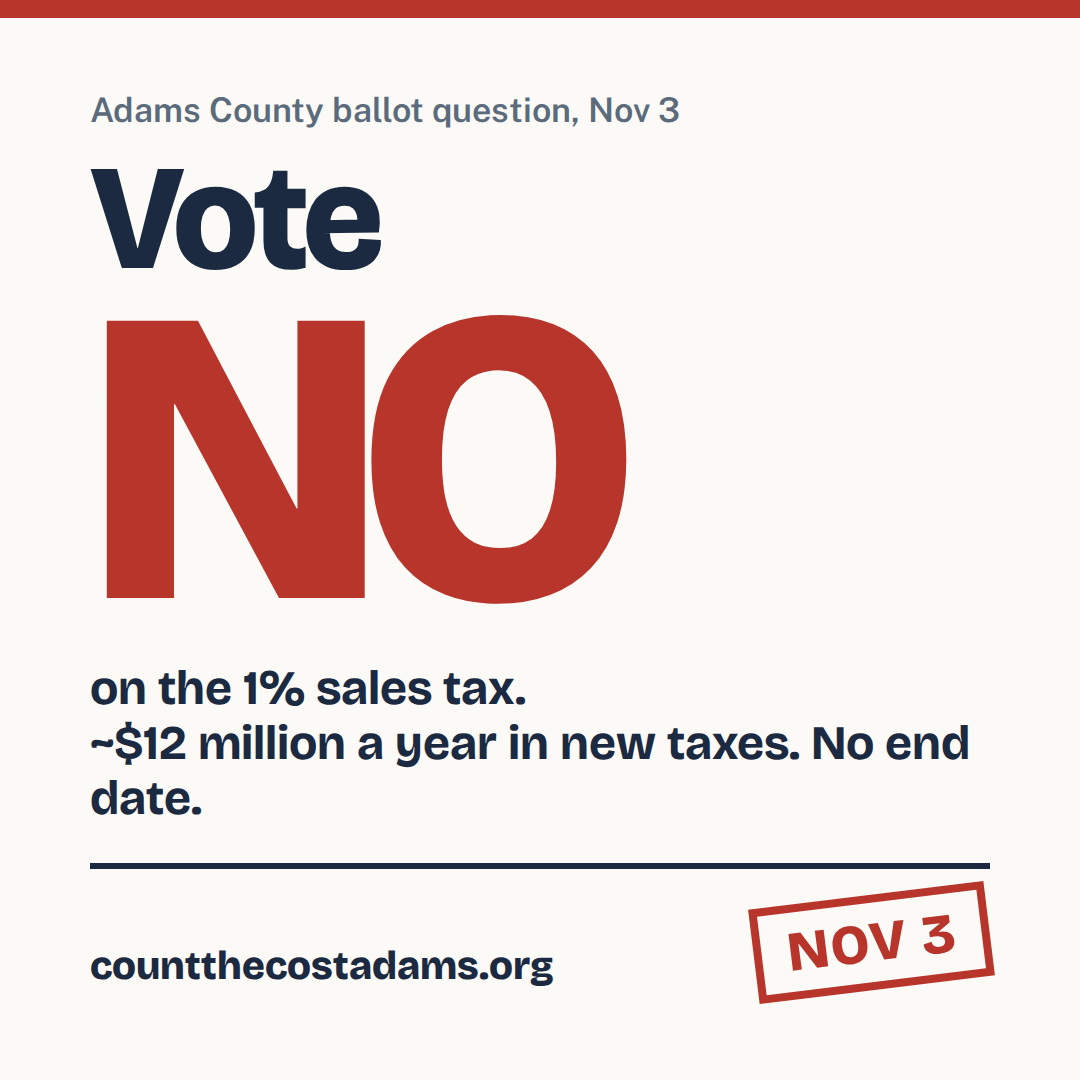
We love our kids and want the best for them, same as the folks running the Vote Yes campaign. Where we part ways is the answer. $12 million a year in new taxes, on top of everything Adams County already pays, with no end date, isn't it. The district's own board update says it may need about $5 million in cuts. Its share of this tax is $8.5 million a year, forever. Show us what was cut from spending before the answer became a tax. Until then, it's a NO.

We agree teachers and staff should be paid fairly.
So does the campaign. The catch is in the law: this tax can't pay a teacher's salary. By statute it goes to buildings, resource officers and mental health staff. If the goal is keeping good teachers, this tax doesn't get there, and the campaign's materials don't say so.The questions their website doesn't answer
We read adamscountykids.org closely, and honestly, we agree with a lot of it. Kids deserve safe buildings and good teachers. What we couldn't find is anything about what was tried before the answer became a new tax. So here's what we'd like to know.
If this tax fails, why should kids or teachers be the ones who feel it?
Every example on the campaign's site ends the same way: no tax, fewer opportunities. But a budget has more than one line in it. Cutting the classroom first is a choice, and we'd like to know why it's the one being put in front of us.
Has spending outside the classroom been looked at?
We're for competitive, reasonable teacher pay. So show us the review of administration, overhead and the other costs that never touch a classroom, the one that happened before the answer became a tax. If it exists, it belongs on the campaign's website. We couldn't find it.
Why is the only choice "more money or fewer opportunities"?
There's a third option most families and businesses in this county already live by. Control costs elsewhere, set priorities, protect the classroom first. None of that is on the ballot, and none of it needs a tax to happen.
What did it cost to ask us for more money?
A year of Quincy Together workshops, a survey, mailers, branding, a professionally built website, and maybe paid planning help along the way. Who paid for each of those, and how much? If any of it came out of district money, that's tax dollars spent to ask for tax dollars, and we'd like to see the invoices.
When the money runs short, what happens?
Sales tax revenue moves with prices. The bills don't. We haven't heard what the plan is for a soft year, and we haven't heard anyone rule out a property tax increase to cover it.
A NO vote doesn't have to mean taking something away from kids or teachers. It can mean: control costs elsewhere, find efficiencies, set priorities, and protect the classroom first.
Trust has to be earned first
A permanent tax is a statement of trust. Before Adams County hands over $12 million a year with no expiration date, it's fair to ask the district that gets 71% of it to show it has fixed what it controls. Here's where we're stuck.
- The ask is bigger than the problem.The district's July 15 board update says it "may be required to make approximately $5 million in budget reductions" starting in 2027-28. Its share of this tax is about $8.5 million a year, with no end date. So even if you take the deficit at face value, the request is $3.5 million a year more than the hole, every year, forever. What's the extra for?
- Quincy Together ended where it started.A year of district-run workshops, a survey, building tours, and the recommendation at the end was a tax, which is where the conversation began. Maybe that's where honest listening leads. The district's own July board update says the process landed on three priorities: strong opportunities, competitive pay and safe buildings. Reviewing spending first wasn't one of the questions, as far as we can find.
- What did the campaign itself cost?Someone is paying for the Vote Yes website, the signs, the mailers and the printing. That's how campaigns work, and there's nothing wrong with it. But the district also spent a year on Quincy Together, and we'd like to know what that cost, which fund paid for it, and whether any of it was spent after the board voted to put the question on the ballot. Illinois lets a district inform voters. It doesn't let one spend public money to campaign, and that line is worth checking.
- Is administration too heavy?Publish the number: administrators and non-classroom staff per teacher, what they cost, and how that compares with 10 years ago. If that ratio grew faster than enrollment did, it's the first place to look, and we'd much rather look there than at a classroom.
- The one-time COVID money is spent. What did it buy?QPS, like every district, got federal pandemic relief that was never coming back, and it's gone. The bus barn spending fiasco is the part everybody remembers. Where's the full accounting of what that money bought, and how much of today's "emergency" was avoidable if it had been spent more carefully?
- Property taxes aren't going down.Nothing in this proposal lowers your property tax bill or caps it. The campaign says the sales tax "won't change the property tax rate," and that's true as far as it goes. It just isn't a promise the rate won't go up for other reasons.
- We've been here before.In March 2020, QPS asked voters to raise the education fund property tax rate from 1.84% to 2.37%. Voters said no, 5,710 to 4,450. The ask is back in a different wrapper, with a better logo and a bigger website. What we haven't seen in the meantime is the spending review that would make this time different.
Fix what you control first, then ask. That's the order every household and business in this county lives by.

It doesn't lower property taxes and it doesn't replace anything. It's an extra 1% on most of what you buy, on top of every tax Adams County already pays, with no end date and no guarantee property taxes stop rising.
Where's the accountability?
We're not against spending on schools. We're against spending that no one has to answer for. Here's the last few years, all from the public record.
- The bus barn went from $3 million to $9 million in a year.In March 2022 the board bought the old K&L Arena for $2 million and figured on $800,000 to $1 million in renovations. Twelve months later it accepted a $7 million construction bid. The project grew, the cost grew, and the answer was to keep going.
- The five new elementary schools already need major HVAC work.Voters approved $89 million in 2014. The buildings opened between 2017 and 2019. In January 2024 the heat failed at all five in one cold snap, 21 compressor failures, and the district is now suing the engineer and the contractor. (And honestly, a couple of those "neighborhood schools" sit out on the edge of town, nowhere near a neighborhood.)
- A full school year of paying people not to work.Two Denman teachers were on paid leave from August 2025 to August 2026 while investigations ran, with substitutes paid to cover their classes. The superintendent was suspended with pay and paid through November under his separation deal, and the district paid an interim $1,000 a day in the meantime.
- Trouble keeping a superintendent.Six people in the job since 2013: three hired, two interims, and the newest started this July. Every change means a buyout, a search firm, and a year of getting to know the district.
- Test scores below the state.On the 2025 Illinois Report Card, 41% of QPS students were proficient in reading and 29% in math. Statewide it's about 53% and 38%. Quincy High's graduation rate is 81% against 88% for the state. More money hasn't been the missing ingredient so far.
Show us the review. Then ask.
What it really adds up to
The campaign leads with 18 cents on a fast-food meal and 64 cents on a tank of gas, and those numbers are true. They're also the smallest numbers available. Their own estimate is about $12 million a year in new taxes, every year, for a county of 65,000 people. Here's that number at full size.
Over time, using their numbers
Take the campaign's claim that 60% of Adams County sales tax is paid by people who don't live here (a number we haven't seen documented). Even then, 40% is local, about $4.76 million a year out of Adams County households and businesses.
These aren't forecasts. They show what the campaign's $11.9 million estimate and its 60/40 split come to if both stayed flat. A percentage tax rises with prices, so flat is the low end.
What would it cost your household?
Move the slider to what you spend in Adams County each month on taxable purchases: restaurants, gas, clothing, electronics, home goods, hardware. Groceries, medicine and vehicles are exempt, so leave those out.
Simple math: 1% of what you spend, at today's prices.
Where does the "60% paid by visitors" number come from?
It's the campaign's best line, and we'd love for it to be true. So far we haven't found anything behind it. Ask them for the study.
- One source, so far.Every place we've seen the 60% traces back to the school district. It was first stated at a Quincy Together workshop in April, and the board's July 15 update repeats it as "projections indicating approximately 60%," without saying whose projections or how they were made. No consultant is named and no state data is cited. If there's a study, it should be easy to share.
- The numbers are already moving.The campaign site says $11.9 million a year. At the district's September open house it was $11.6 million. Nothing about the tax changed in between. When an estimate drifts before the vote, it's fair to ask how firm the rest of it is.
- 60% is a tourist-town number.The usual way this gets estimated is a "pull factor": how much the county sells per person compared with the state average, with everything above average credited to outsiders. For 60% to hold, Adams County would have to sell about two and a half times the state average per resident. That's a Galena or a Branson. Regional shopping towns like Quincy, as best we can tell, land somewhere around 25 to 40%.
- The method can't tell a visitor from a neighbor.Pull-factor math counts every above-average dollar as an outsider's dollar. It can't tell a family driving over from Hannibal from a Quincy family that shops at home because that's where the stores are. Adams County has about 65,000 people and 40,000 of them live in Quincy. Most of the money spent in Quincy is Quincy's.
- The county's own jail tax backs the total, not the split.Adams County already collects a quarter-cent public safety sales tax on the same base as this one. The county's own funds report shows about $1.5 million into that fund in the first half of fiscal 2026, roughly $3 million a year, which works out to a taxable base near $1.2 billion. One percent of that is about $12 million. So the campaign's revenue total looks about right. The 60% is the part still missing a source.
The County Treasurer's actual public safety tax collections for a full year would pin the base down exactly. It's a public record, and there's a ready-made request for it further down the page.
What if the 60% is wrong?
The campaign's total stays at $11.9 million either way. The only thing the visitor share changes is how much of it comes out of Adams County wallets. Move the slider. The results below are what Adams County residents and businesses pay.
At the campaign's 60%, locals pay $4.76 million a year. At 35%, it's $7.7 million. That's a $60 million difference over 20 years, riding on a number we haven't seen documented.
And if it's off, the cost to local families roughly doubles.

Yes, gasoline is included
The campaign's examples list a "$64 tank of gas: 64 cents" and move on. Gas deserves a closer look, since Illinois already taxes it about as hard as any state does.
At $3.50 a gallon, another 1% is 3.5 cents per gallon, about 53 cents on a 15-gallon fill-up. That's on top of the Illinois Motor Fuel Tax, currently 48.3 cents per gallon on gasoline, plus state and local sales tax that already applies to fuel here.
Because this is a percentage, it rises with the pump price. At $4.20 a gallon it's 4.2 cents. That part doesn't show up in a campaign example.
| Pump price | Per gallon | 15-gal fill | Per year (2 fills/wk) |
|---|---|---|---|
| $2.00 | 2.0¢ | $0.30 | $31 |
| $3.50 | 3.5¢ | $0.53 | $55 |
| $4.20 | 4.2¢ | $0.63 | $66 |
Per vehicle. A two-car household roughly doubles it.
At the pump
Set the price and how much you drive.
What happens when prices fall, and why there's no end date
The campaign says the tax grows with visitors' spending. Fair enough. It also shrinks with it, because a percentage tax is only as steady as prices are.
Take gas again. If the pump price drops from $4.20 to $2.00, the tax collected on every gallon falls by more than half, about 52%. That's one category. Every category behaves the same way when prices soften.
So here's the question we'd like answered: once the districts have built budgets around $11.9 million a year and a soft year delivers a lot less, what fills the gap? A property tax increase is the obvious tool, and we haven't heard anyone take it off the table. There's no guarantee in this proposal that property taxes won't keep rising, and honestly, there isn't even a promise.
The question on your ballot:
"Shall a retailer's occupation tax and a service occupation tax (commonly referred to as a 'sales tax') be imposed in Adams County, Illinois, at a rate of 1% to be used exclusively for school facility purposes, school resource officers, and mental health professionals?"
There is no end date in that sentence. The Illinois statute this tax is created under doesn't set one either. Once approved, it stays until voters go back to the ballot to remove it.
County school facility sales taxes in Illinois are authorized under 55 ILCS 5/5-1006.7. The rate can only be changed or ended by another referendum.
How long until we're told this tax needs to go up, or that cuts to teachers and students are coming again?
It's a county vote. It's a Quincy tax.
The campaign says "every district, every community," and that's true on the ballot. Look at where the money goes, though. Quincy School District 172 gets about 71 cents of every dollar. This is a QPS funding plan that needs the rest of the county's votes to pass.
Shares from the campaign's own district table (~$8.5M of ~$11.9M to QPS).
Camp Point, Liberty, Mendon and Payson each have their own school board, and each can put its own question to its own voters for what its own buildings need. What this ballot does instead is ask a farmer in Payson and a shop owner in Camp Point to chip in every time they fill up, so Quincy's district can put off a budget conversation it hasn't had yet.

Illinois residents already carry one of the heaviest state and local tax loads in the country. A new permanent county tax on top of it, with no spending review first, is a lot more than "a penny." It means we've quit asking where the money goes.
Their examples, finished
The campaign's "every day examples" table stops at a single purchase. Here it is carried through a year.

| Example | Their number | Over a year |
|---|---|---|
| $18 fast-food meal, twice a week | 18¢ | $18.72 |
| $64 tank of gas, weekly | 64¢ | $33.28 |
| $500 laptop | $5 | $5, plus every other purchase |
| $1,200 washer and dryer | $12 | $12 |
| $300/month at restaurants and stores | $3 | $36 |
| A local business buying $20,000/month in taxable supplies | $200 | $2,400 |
| Adams County, all of us | "just a penny" | $11,900,000 |
Yearly figures are the campaign's single-purchase numbers multiplied out. Groceries, medicine, vehicles and services stay exempt.
Questions people ask us
Aren't you just against schools?
No. We're against being handed a permanent tax before anyone shows the work. We're for competitive teacher pay and safe buildings, same as you. We'd like the districts to show what they cut, consolidated or renegotiated before asking the county for $11.9 million a year.
The campaign says most of the money comes from visitors. Doesn't that make it nearly free?
Start by asking where the 60% came from. We haven't found a published study, and the only source we've seen is the district. Regional shopping towns usually pull somewhere around 25 to 40% from outsiders. But even at their figure, 40% is local: about $4.76 million a year, $47.6 million over 10 years, $142.8 million over 30. And visitors don't vote here, and they won't be at the meeting when the projections miss. See the 60% section.
Doesn't the money have to be spent on facilities, safety and mental health?
Yes, and that's the problem with how it's being pitched. The campaign's own site says the money can't be used for salaries, so "keep the teachers our kids love" is a promise this tax can't legally keep. Money does move inside a district budget, though. Every dollar this tax covers frees up a dollar somewhere else, with no strings on it.
Isn't 1% small?
1% of a meal is small. 1% of everything Adams County buys, every year, with no end date, is $11.9 million by the campaign's own estimate. Both things are true. Only one is on their website.
Why does an end date matter?
Because "forever" is a different question than "for ten years to fix specific buildings." A sunset forces the districts to come back and show what the money bought. Without one, the tax outlives every project it was pitched on. The ballot question has no sunset, and the statute doesn't require one.
Didn't Quincy Together ask the community what it wanted?
It asked. It also ran the meetings, wrote the survey, chose the options, and landed on a recommendation the districts had likely been discussing among themselves well before the first workshop. Asking people to rank what a new tax should buy is a different question from asking whether spending was reviewed first, and that second one never made the survey.
Will this lower my property taxes?
When was the last time your property taxes went down? No. Nothing in the ballot question reduces, caps or replaces property taxes. This is an additional tax. The campaign's line that it "won't change the property tax rate" just means this vote isn't what raises it.
How much did Quincy Together and this campaign cost?
We haven't been told. Between the workshops, the survey, the mailers, the branding and a professionally built website, it wasn't free, and that's fine; campaigns cost money. A committee called Citizens For One Quincy is registered with the Illinois State Board of Elections, and committee expenditure reports are public. The district's own spending on Quincy Together is a FOIA request away. We think both numbers belong next to the words "we can't afford to keep teachers."
What about the federal COVID money?
QPS, like every district, got one-time pandemic relief, and it's gone. We don't know exactly what all of it bought, and that's the point. The bus barn spending fiasco is the part people remember. A full accounting of that money belongs in front of voters before anyone asks for a permanent tax. Ask for it.
What happens if it fails?
The districts keep every dollar they have today and go back to work on the budget, same as the rest of us. If a specific, time-limited plan comes back with a spending review attached, it can go on a future ballot. This isn't the last election.
Who's behind this site?
Adams County residents and taxpayers who love their kids and their county. No school district, no party. If you'd like to help, see Get involved.
How to vote NO
Same dates and polling places as every other race on the ballot. The question is easy to miss, so look for it.
Check your registration
Visit elections.il.gov to confirm you're registered and find your polling place.
Pick how you'll vote
Vote early from September 24, request a vote-by-mail ballot, or vote in person on November 3.
Find the question
It's a countywide question alongside the candidate races. Read the whole thing, and notice it has no end date.
Mark NO
Then tell a neighbor who figured a penny couldn't add up to much.
Voting logistics
Contact the Adams County Clerk's office.
Phone: 217-277-2150
Website: adamscountyil.gov
Want to read the other side? Their site is adamscountykids.org. Read it, honestly, and then come back and see whether any of the questions above got answered.
Fix the spending. Show the books. Then ask.
We agree with the campaign on this much: our kids count on us. That's exactly why we're asking for answers before we hand over $12 million a year of new money with no end date. There's no office behind this site, no staff and no budget, so everything below is something you can do yourself in the next 10 minutes, and none of it waits on anyone.
Print a window sign
Letter size, black and red, prints on any home printer. Two versions: a big NO for a window or mailbox post, and a five-facts sheet for a break room or shop counter.
Open the sign and printSend this to three neighbors
The other side has the district's Facebook page and a professional website. You have a phone. Text 3 people who haven't thought about it yet.
Put the dates on your calendar
Early voting is open now. Election Day is Tuesday, November 3, polls 6 a.m. to 7 p.m. Add a reminder so it doesn't slip.
Ask the district for the 60% study
Email it to foia@qps.org, use the district's contact form, or hand it to a board member at the next meeting. If a study exists, they can attach it. If it doesn't, you'll know that too. Copy, paste, send.
Ask the County for the real number
The Adams County Treasurer already collects a quarter-cent sales tax on the same base as this one. Actual collections are a public record. One FOIA request settles the taxable base. Email it to treasurer@co.adams.il.us (Bryden Cory, County Treasurer, 217-277-2245) or drop it at 507 Vermont St., Suite G12.
Ask what the campaign cost you
Planning help, surveys, printing, the website. If the district paid for any of it, that's public money and a public record. Email it to foia@qps.org (Kimberly Wert, Board Secretary and FOIA Officer, 217-223-8700) or hand it in at 1416 Maine St.
Show up and ask, out loud
School board meetings are public and have a comment period. The schedule is on qps.org. You get about 3 minutes. Spend them on these three questions and ask for a written answer.
Write a letter to the editor
200 words, your own name, one point. The Herald-Whig and Muddy River News both print them. Pick one number from this page and say what it means for your family or your business.
Share a graphic
Pick one. Copy the caption (the link is in it). Save the image. Post both together and Facebook shows the picture with the link underneath. Squares for the feed, tall ones for Stories.